Start with the money available now
Use the balance you can actually spend, not a credit limit or an expected payment that has not arrived. List the accounts included in your plan and check pending card payments. A transfer between your own accounts is not new income.
Put bills on the right dates
List rent, utilities, insurance, subscriptions and required debt payments due before the next paycheck. A monthly total can hide timing problems when a large bill is due shortly after one of two paychecks. Use a calendar to make the gap visible.
A $1,400 paycheck example
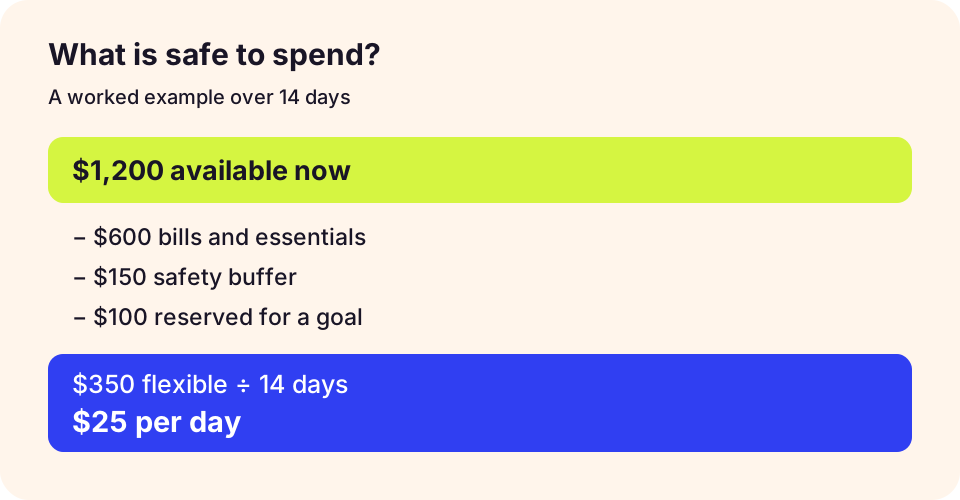
Suppose $1,400 is available for the next 14 days. You reserve $700 for bills and essentials, $200 as a buffer and $150 toward savings. That leaves $350, or $25 a day. These are illustrative amounts, not recommended targets.
Review after each purchase
If you spend $45 on the first day, $305 remains for the next 13 days, about $23.46 per day. Update the record before using the new figure. If a bill was already reserved, avoid subtracting it again as though it were a new commitment.
Use Headway for the next decision
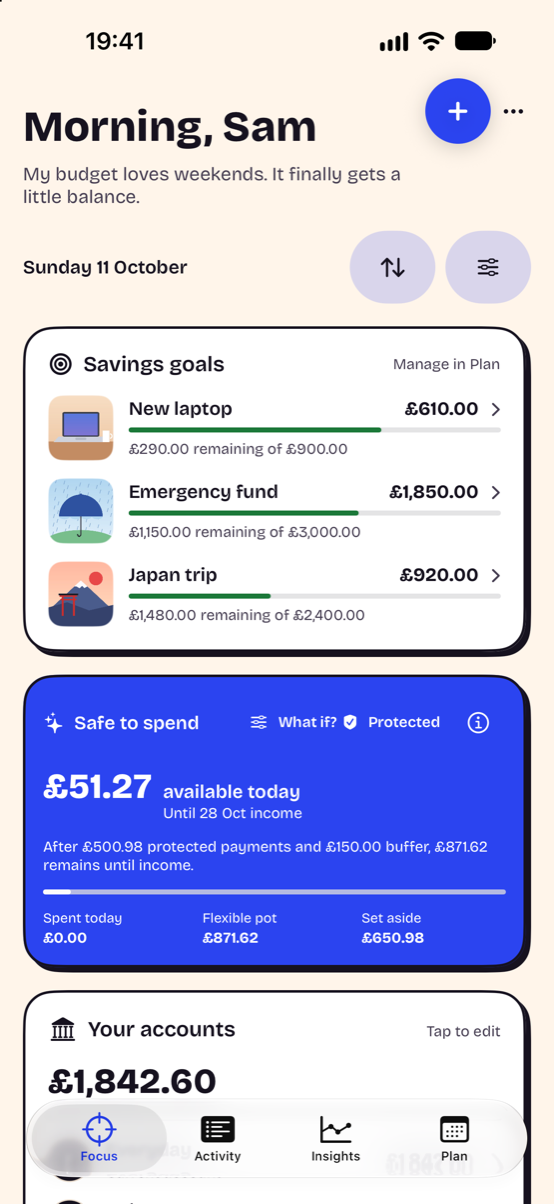
Enter the account balance, next income date and protected commitments, then use Focus for the daily Safe to Spend estimate. Activity holds your recorded purchases and Plan holds upcoming items. Headway does not require a bank connection or a separate login.
What if a paycheck arrives late?
Use a cautious date when pay varies. Review the plan before a large purchase and keep a buffer when possible. If essentials cannot be covered, contact creditors or an appropriate support service rather than treating a daily estimate as permission to borrow.
The CFPB’s Your Money, Your Goals toolkit includes a cash-flow budget and bill-calendar worksheets. This guide uses those general planning concepts with a Headway example; it is not personalised financial advice.
Keep planning
Try the safe-to-spend calculator, read how safe-to-spend budgeting works, explore private budgeting or compare Headway and YNAB.